Women in Technology
  • About Us
    • Our Mission and History
    • WIT Leadership
    • Annual Reports
    • News and Insights
    • WIT Career Center
  • Programs
        • Pre-Career
          • WIT Girls
          • WIT Campus
        • Careers in Action
          • WIT Early Career
          • WIT Forums
          • WIT Elevate
          • WIT Technology Uncorked
          • WIT SMP Graduate Success Network
        • Community-Wide Events
          • WIT Awards
          • WIT Connect
          • WIT Careers in Action Summit
          • WIT Socials
        • Events Calendar
  • Support
    • Partnerships
    • Strategic Volunteering
    • Donate
    • Shop
  • Join WIT
  • Donate

The Real Question Isn’t “Am I Ready for More?” It’s “Is This Worth It?”

August 14, 2026 by ameredith Leave a Comment

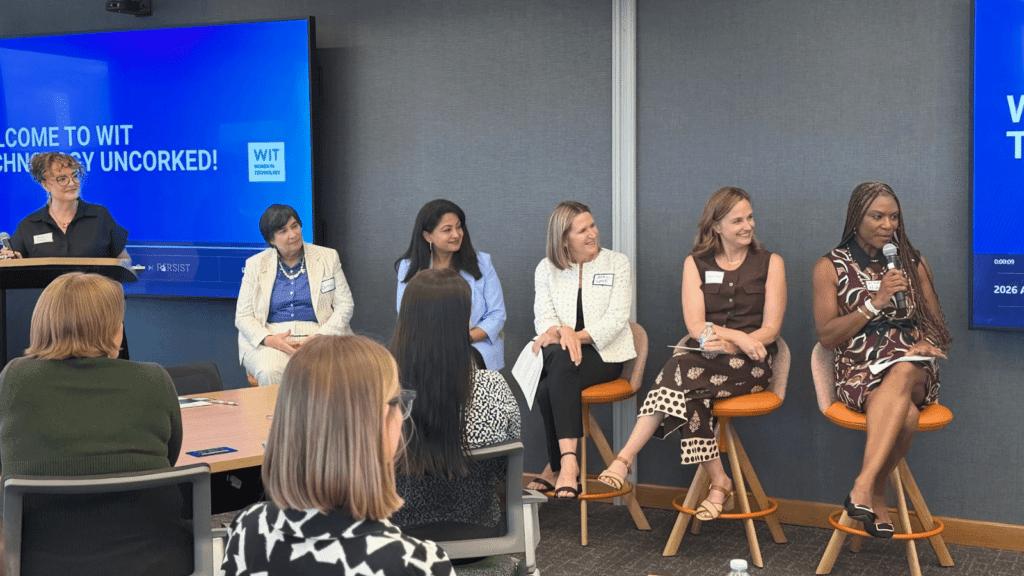
Five women sit on stools speaking at a panel in front of an audience, with a presenter standing at a podium and a blue screen behind them reading Welcome to WIT Technology Uncorked!.

Inside our August WIT Technology Uncorked

The August WIT Technology Uncorked brought together five women who have each, at some point, had to decide whether to stay, push back, or walk away from a role that looked good on paper but didn’t add up in practice. The theme: responsibility without recognition, and what to do when you’re handed the work but not the title, the trust, or the pay to match.

Our moderator opened with a story a lot of the room recognized immediately: being “promoted” in name only, more than once, by the same company. It set the tone for a conversation that wasn’t about complaining. It was about the moment of clarity that comes right before a real decision.

How do you know if it’s still worth it?

The first question of the night set up the whole conversation: how do you evaluate whether your organization still deserves your investment?

The answers converged on three things worth checking for, whatever stage of your career you’re in.

Peace of mind. Not just satisfaction with the work, but the ability to actually stop thinking about it when you walk away from your desk. If you’re doing your best thinking at 3am, that’s a signal, not a badge of honor.

Sponsorship, not just mentorship. One panelist drew a sharp line between the two: mentors give you advice in the room. Sponsors talk about you when you’re not in it. If leadership isn’t doing the second one, the first one doesn’t count for much.

Investment in the work itself, not just in you. A team can champion you personally and still starve your project of funding. That gap is worth watching.

Culture came up as its own category entirely, and the panel was clear that it isn’t one thing. There’s the culture of the company, and there’s the culture of your specific team, and they can be completely different animals. One panelist described watching a strong, inclusive culture quietly erode after the leader who built it moved on, and not seeing it happen in real time. “When you’re in it, you don’t see it,” she said. “Later on you’re like, that was a full force hurricane.”

Advocating from the inside

The conversation shifted to what it actually looks like to push for change without leaving. The advice was less about big speeches and more about specificity: figure out exactly what you need, ask for it directly, and frame it in terms the business understands.

One panelist described telling her manager plainly that she’d be gone certain afternoons for her kids’ games, and that the tradeoff was a better, more present version of her at work the rest of the time. Another described asking her provost for a salary adjustment based on public pay records, being turned down, and using that as the push to leave for an opportunity that nearly tripled her salary.

The through-line: know your own value before you ask anyone else to recognize it, and be ready to act on what you learn either way.

Investing in your own career, on your own terms

By the end of the night, the room had moved from strategy to something more personal. Several panelists talked about reaching a point where they stopped waiting for someone else to notice their work and started asking for more of it directly, whether that meant more responsibility, a renegotiated role, or a title that finally matched what they’d already been doing for years.

One panelist summed up the throughline of the whole evening: find the work you’d want to keep doing even if no one were watching, and then make sure someone is.

The evening closed with a moment of quiet reflection, giving everyone in the room a chance to write down what had landed for them, and where they might be carrying work that isn’t being recognized in their own careers right now, before moving into table conversations to talk it through with each other.

Meet the panel

  • Kerri Sauer (Moderator), FinTech & Technology Leader
  • Dorren Schmitt, Ph.D., VP of IT Strategy and Innovation IT & Cybersecurity, Allen Media Group (parent company of The Weather Channel)
  • Akhila Gullapalli, VP of Data and Tech, Fiserv
  • April Lake, CIO, Novelis
  • Leanne West, Chief Engineer of Pediatric Technology, Georgia Tech; Chief Research and Innovation Officer, Shriners Children’s; President, International Children’s Advisory Network
  • Windy Nicholson, former VP of Product M&A, Salesforce; Tech Executive & Nonprofit Board President


Women in Technology (WIT) creates possibilities for more women to explore, pursue, persist, and lead in technology. Learn more at mywit.org.

Filed Under: Event/Program Recap, Thought Leadership, WIT Technology Uncorked

The Meetings Before the Meetings

July 10, 2026 by ameredith Leave a Comment

There’s a moment most of us have experienced: You walk into a room thinking a decision is still on the table, and you quickly realize it was made before anyone sat down. The meeting was a formality. You just didn’t know it.

The women who shape decisions, the ones who actually move things forward, know something the rest of the room doesn’t always see. The real work happens before the calendar invite goes out.

At a recent Women in Technology (WIT) Technology Uncorked event, a panel of senior leaders in technology and strategy gathered to talk about navigating power, pushback, and decision- making. And across every story they shared, one strategy surfaced again and again: Do the meetings before the meetings.

What that actually means

It’s not about going around people or playing political games. It’s about doing the relationship work that makes the formal meeting matter.

One panelist described leading a new product initiative at The Coca-Cola Company. She walked in with a room full of longtime employees who immediately pushed back. “We tried it. It won’t work. There’s a white paper that says so.” Instead of defending the idea on the spot, she paused. She went back and had individual conversations. She found out who had reservations, and more important, she learned why. She identified her champions. She understood the history.

Then she came back with a real business case, answers to the objections, and with the people in the room already partially won over.

“I had the meetings before the meetings,” she said. “And I love hearing the pushback, because that way you can position it when you’re in the real meeting. You can say, I heard you. This is what we’re doing about it.“

Influence doesn’t live in your title

Another panelist made a point that reframes how most of us think about organizational power. She had grown up in her company, risen through the ranks, earned her C-level seat, and discovered that one director in a finance support function had more influence over hiring decisions than anyone with a formal title.

“It wasn’t me with my C title or the CEO who told me it was approved. Ultimately, she had the influence and helped drive that for the entire organization.”

The lesson: Influence is informal and distributed. It lives in relationships, in trust, in who people call when they need to think something through. And you don’t find that out from an org chart. You find it by paying attention, building relationships across levels, and as one panelist put it, going to the food court.

“You start to see who hangs out with each other, whose kids go to school together, who’s neighbors with who. And then you start to understand how influence actually moves.”

Resistance Is data

Every panelist had experienced pushback. The kind that’s obvious, and the kind that isn’t. Silence in a meeting. An idea attributed to someone else. A decision quietly reversed after you leave the room.

Their advice wasn’t to avoid conflict or push harder. It was to get curious.

“When I find resistance, I say: ‘I feel some tension here. Tell me what I’ve missed. Help me understand what you see as a blocker.” One panelist described this as turning resistance into information. “The resistors give you so much data. They show you the path. They tell you exactly what you need to address.”

That reframe matters. Pushback isn’t a wall. It’s a map.

Building alignment is the job

As careers advance, the work shifts. It’s less about executing tasks and more about building consensus, removing obstacles, and moving ideas through people.

“When we’re younger in our careers, it’s all about the task,” one panelist reflected. “The further we progress, all of my time is spent shaping, influencing, working with peers, and helping move ideas forward.”

That’s not a soft skill. That’s leadership. And it requires a different kind of preparation than most of us were taught.

The meeting before the meeting isn’t a trick. It’s the practice of showing up to formal moments with the relationships, information, and alignment already built. It’s how decisions get made, and how you get to be part of making them.

Try it this week

Before your next important meeting, ask yourself:

  • Who in this room hasn’t been heard yet?
  • Who are my potential champions, and have I talked to them?
  • What’s the real resistance, and what does it tell me about what I still need to address?
  • Is there a conversation I can have before that would make the formal meeting more productive?

The goal isn’t to predetermine the outcome. It’s to show up prepared, to bring people along, and to lead in a way that makes the work, and the people doing it, better.


This insight was drawn from a WIT Technology Uncorked event on navigating power, pushback, and decision-making. Women in Technology (WIT) creates possibilities for more women to explore, pursue, persist, and lead in technology. Learn more at mywit.org.

Filed Under: Event/Program Recap, Thought Leadership, WIT Technology Uncorked Tagged With: career development

Frame Your Impact, Not Just Your Effort

March 12, 2026 by ameredith

High performers often fall into the “invisible work” trap: they deliver consistently, solve problems, and get results, but their contributions go unnoticed. Doing great work is essential, but it’s not enough to advance your career. What separates those who get recognized from those who don’t? How you communicate your impact.

Why Communication Matters

Executives and leaders aren’t looking at hours worked or tasks completed. They care about outcomes that affect the business. Your goal is to help others see the value you create, so your work leads to opportunities, promotions, and influence. In a recent session of WIT Technology Uncorked, one thought-leader shared that framing work in terms of business impact is a game-changer: instead of saying, “I implemented a new access management tool,” say, “This new tool reduced login issues by 40%, saving the team 10 hours a week and improving productivity.”

Use Storytelling to Make Your Work Memorable

How you tell your story matters as much as what you did. Use a simple narrative:

  • Beginning: What problem or challenge existed?
  • Plot: What actions did you take?
  • Takeaways: What measurable impact did your work have?

Visibility Is Key – Inside and Outside Your Organization

It’s not enough for your manager to notice you. Influence comes from multiple angles: peers, other teams, HR, and executives. Share your wins across teams. Build an external presence through LinkedIn posts, speaking engagements, or writing articles.

Practical Steps You Can Take

  • Write a 3-line impact story for each major project
  • Highlight the business results in updates or meetings
  • Explain how your work benefits others, not just what you did
  • Build an external presence through LinkedIn posts, talks, or articles

High performance will get you far, but strategic storytelling and visibility take you further.

Filed Under: Thought Leadership, WIT Technology Uncorked Tagged With: career, impact, leadership, promotion, storytelling, visibility

Working Hard is Not a Promotional Strategy

March 10, 2026 by ameredith

If you’re the “reliable doer” on your team – the one who always delivers, works late, and gets it done – you’re valuable. But that alone won’t get you promoted. In a recent session of WIT Technology Uncorked, one message was clear: Performance builds trust. Visibility builds opportunity.

Many women hit a point where they realize: others are getting promoted, their work is being credited to someone else, or they’re praised but not advanced. Why? Because promotions aren’t based solely on effort. They’re also based on perceived impact. Research shows that women are promoted at lower rates at the first step to manager, even when performance is strong.

What Actually Moves You Forward

  • Build advocates. Promotions are often decided in rooms you’re not in. If no one there understands your impact, your name won’t come up.
  • Learn the business. Technical skill is expected. Business fluency is differentiating. Talk about outcomes (revenue, risk reduction, efficiency) not tasks.
  • Communicate in benefits, not busyness. Saying “I worked all weekend” doesn’t land. Saying “This reduced processing time by 30%” does.
  • Create opportunities. If the next role doesn’t exist, build a case for it. Line up support before the big meeting.

Hard work makes you dependable. Strategic visibility makes you promotable. If you feel stuck, the answer isn’t to work harder. It’s to make sure the right people see your impact.

Filed Under: Thought Leadership, WIT Technology Uncorked Tagged With: advocacy, career, leadership, promotion, visibility, women in tech

wit-logo-white.svg

About us

  • Our Mission and History
  • WIT Leadership
  • Annual Reports
  • News and Insights
  • WIT Career Center

Programs

  • Pre-Career
  • Careers in Action
  • Community-Wide Events
  • Program Events

Support

  • Partnerships
  • Strategic Volunteering
  • Donate
  • Shop

CONtact us

1750 Powder Springs Rd
Suite 190 #256
Marietta GA 30064

Phone: 470-264-1780

Charity Navigator Four-Star 2026 badge with four blue stars in squares, charity name at top, and rounded blue border.
A white square badge with text: Platinum Transparency 2026 in black, and Candid. below, bordered by a light blue frame.
Connect with Us
Facebook (opens in new tab) Instagram (opens in new tab) LinkedIn (opens in new tab)

WIT is a tax-exempt 501(c)(3) nonprofit organization. Your gift is tax-deductible as allowed by law. WIT's tax ID number is 31-1839582.

© 2026 Women in Technology. All Rights Reserved.