September WIT Forum | September 16 | 7:30–9 am ET | Maggiano’s Buckhead
Presented by Tier4 Group
The September WIT Forum tackled a subject every technology professional runs into at some point, whether they’re managing a team or building their own career: retention. Presented by Tier4 Group, “The Retention Equation: Personal Investment + Organizational Responsibility” asked what it actually takes to keep good people, and made clear the answer runs in both directions. It’s not just what organizations owe the talent they’ve invested in. It’s what individuals owe their own career journeys, the choices they make about where to grow and when to move on. Attendees, themselves technology professionals navigating that exact equation, gathered over breakfast before settling in for a panel discussion, table conversations, and audience Q&A.
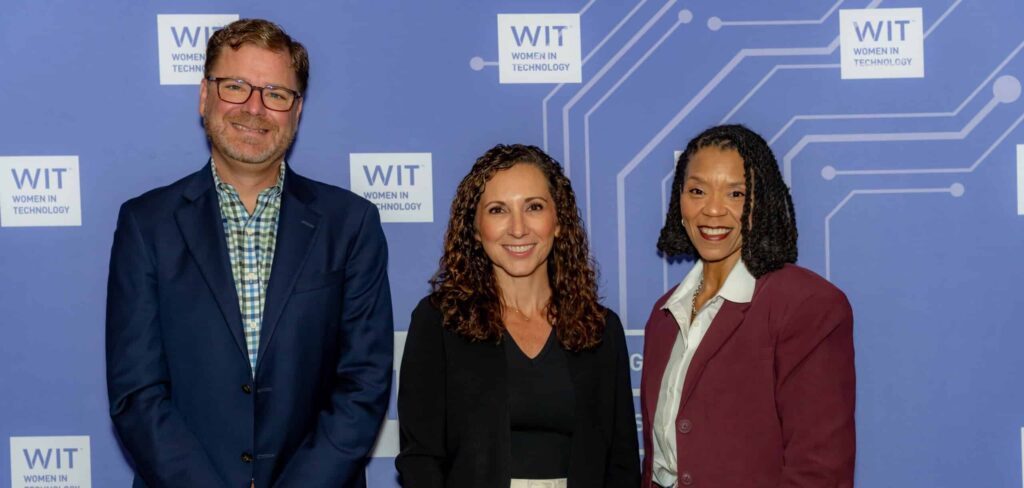
Katie Logan, Chief Strategy Officer at Gozio Health, moderated a panel that brought together Oneka Jefferson-Cornelius, Senior Director of Human Resources and Atlanta Hub HR Lead for Digital Technology & Data at Cargill, and Mike Park, SVP and Chief Information Officer at Infor. Katie opened by pulling the word “retention” apart. It comes from the Latin retinere, to hold back, the same root as detain and contain. The point landed early and set the tone for the rest of the morning: retention isn’t the absence of people leaving, it’s the presence of reasons to stay. Those are two different measurements, and two different plans.
From there the conversation split cleanly along the line the title promised. On the organizational side, Mike talked about giving people the tools and room to grow rather than trying to hold them in place, including making sure teams have real access to AI so they don’t fall behind. Oneka described the work being done to future-proof the company’s tech organization over the next 12 to 18 months, from individual development plans for every employee to a hard rule held as a leadership standard: if someone doesn’t want to be held in a role, it’s the leader’s job to help them move up, out, or over, inside the company or outside it.
On the individual side, both Oneka and Mike pushed back on the idea that a company should already know what someone wants from their career. Employees, they argued, have to own that story themselves, document their goals, ask for stretch assignments, and treat a next move as something to run toward rather than something to run from. Katie closed that thread with a line that landed hard in a room of women in tech: that too many of us still undersell ourselves or wait to be asked, instead of raising our hand.
Notable Quotes
“Retention comes from the Latin retinere, to hold back, the same root as detain, the same root as contain. Maybe we think about it not as the absence of people leaving, but the presence of reasons to stay.”
“We want people to be excited about staying, as opposed to containing people. So we’re trying to give them the tools and the environment to grow in their roles, and really encouraging them to be curious on their own.”
“I am not a firm believer that any organization should hold someone who doesn’t want to be held. It’s my job to clear barriers and help you move up, out, or over, whether that’s in this organization or outside of it. I didn’t fire you. What I did was untether you.”
“There are times when people do leave an organization because the dynamic has shifted, especially for women, women of a certain age, women of a certain background. Those things aren’t within our control. But you can control the controllables.”
Tactical Takeaways
For your own career:
- Write down your own career narrative — goals, wins, what you’re building toward — rather than waiting for a manager to infer it. One panelist put it directly: it’s on you to give your leader “the story to tell.”
- Before a 1:1 or review, ask for something specific rather than a general “what do you think.” A targeted ask reads very differently than “I’m ready to be promoted, what do you want to do?”
- Use the “running to, not from” gut check before making a move: if you’re chasing something that excites or challenges you, that’s a good sign. If you’re only trying to escape something, slow down.
- Raise your hand for the tools, not just the assignments. Multiple panelists pointed to AI fluency specifically as something people wait to be invited to instead of asking for outright.
- Think in skills, not titles. Treat your capabilities as portable across roles and industries rather than tying your identity to a job description that may already be outdated by the time it’s posted.
For managers and organizations:
- Equip teams with real AI tools and clear governance, so people are experimenting safely and openly rather than finding workarounds or falling behind quietly.
- Ask people directly what they need to do their best work, and ask it as an open question, not a checklist. The exact prompt one panelist uses: “What needs to be true about this role, our culture, and our environment for you to do your best work?”
- Build individual development plans for every employee, not just top performers or people already on a leadership track.
- Plan for early-career talent on a realistic 2-to-3-year horizon instead of assuming long tenure, and build reasons to stay into that shorter window rather than treating it as a loss.
- Treat departures as reversible, not personal. Stay connected with people who leave. Several panelists pointed to boomerang hires as evidence that a good exit is still a relationship worth keeping.
Check out the photos from the 2026 September WIT Forum.
Thank You to Our Partners
This forum is made possible by the generous support of our partners.
A special thank you to our Presenting Partner, Tier4 Group, for their commitment to advancing women in technology and making conversations like this one possible.
Thank you to our additional WIT Forum Partners
We’re also grateful to our additional partners for their continued investment in this community: Adapture, Brooksource, Cargill, CDW, Cox Enterprises, Fiserv, Genuine Parts Company (GPC), Georgia-Pacific, Google Cloud, Infor, Kimberly-Clark, Norfolk Southern, Pyramid Consulting, QTS, Rollins, Salesforce, Southwire, State Farm, Synchrony, The Coca-Cola Company, The Home Depot, and Truist.
Women in Technology (WIT) creates possibilities for more women to explore, pursue, persist, and lead in technology. Learn more at mywit.org.