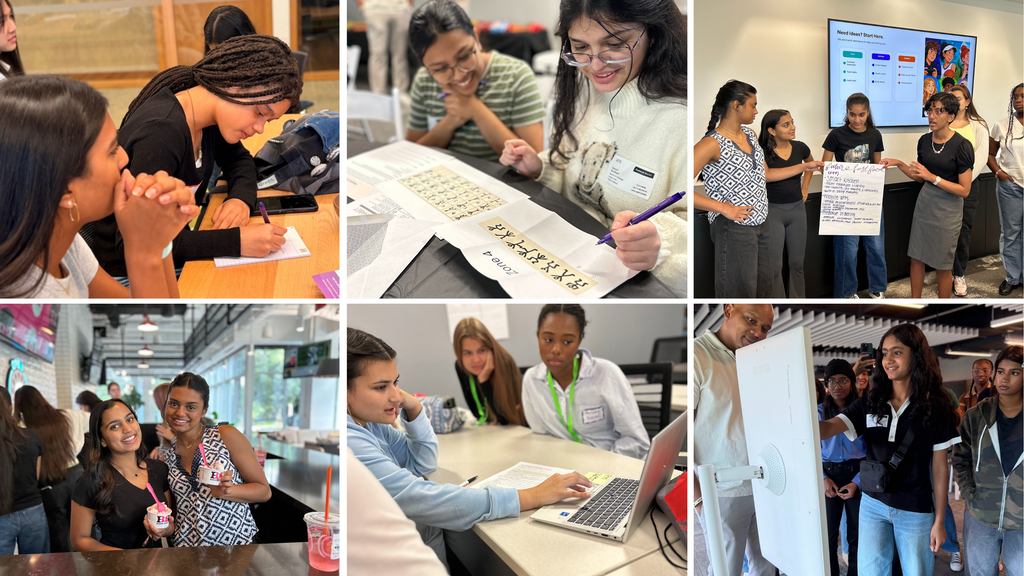
For one week this summer, WIT Girls spent their days inside twelve different companies, not touring them from the outside, but sitting in on panels, taking apart computers, pitching business ideas, and more!
“I feel like I belong here”
At Cargill, after a session with engineers and interns, one of the program leaders asked the girls a simple question: how did it feel to meet engineers who looked like them? The answers said everything.
“It really made me feel like I belong here,” one girl said. Another put it even more plainly: “You can be whoever you want to be despite what you look like.”
That sense of belonging showed up again and again in the post-event survey. Girls wrote about feeling less pressure to have their whole future figured out, about realizing tech didn’t require a “perfect, linear pathway,” and about seeing women doing real work in rooms they’d assumed weren’t for them. One girl summed up the week this way: it “helped me see women’s representation in male dominated fields which helps me see myself in their place.”
Career paths that don’t go in a straight line
If there was one idea that followed the girls from company to company, it was this: nobody’s path looks the way you’d expect.
At Cox Enterprises, a panelist told the group her own story, she started out as a WIT Girl herself and is now interning at Cox. It’s exactly the kind of full-circle moment the program is built to create. The advice that stuck with the group that day was simple: you don’t have to pick one path and lock yourself into it forever. You’re not Rapunzel. You’re not stuck in the tower.
Girls heard some version of that message everywhere they went. At QTS Data Centers, employees from wildly different backgrounds and majors talked about how they ended up there. At Improving, girls heard “don’t apologize for being in spaces you should be in.” At Truist, a full-circle WIT member named Ramona Lopez, who used her own WIT network to land her internship there, told the girls to follow their passion until they find the spark, then stay flexible, because the path will change more times than they expect.
By the end of the week, it showed up in their own words. Nearly every girl who filled out the survey said the program changed how they think about their future, and the phrase “career paths aren’t linear” showed up so often it was practically a refrain.
Hands-on, not just talked-at
The girls didn’t just listen, they built things.
At Improving, they took apart a desktop computer piece by piece, then turned around and learned cryptology well enough to make bracelets encoded in Morse code and binary. At Cox, they interviewed a Cox employee and built her a custom couch prototype based on what she told them she wanted. At Fiserv, every girl built her own small business inside a live payment system, then pitched it Shark Tank style in front of the whole group.
At Zebra Technologies, the day turned into a capture-the-flag game built around RFID tags, racing through a simulated supply chain, followed by a precision challenge to get as close as possible to a scanner without triggering it. At QTS, the week’s most talked-about moment might have been the last one: building the tallest tower they could out of marshmallows and spaghetti.
It’s not a coincidence that the moments girls came back to again and again in their survey responses were the hands-on ones. When asked what they’d want more of, the answer was almost unanimous: more activities, fewer straight lectures. It’s a note we’re taking seriously for next year.
Honesty, from people who’ve actually lived it
However, some memorable moments of the week weren’t activities at all, they were the honest conversations.
At State Farm, girls heard directly from leadership, one of whom told them, “It is normal to be uncomfortable, but you need to learn to work through it or you will hinder your growth.” At Inspire Brands, girls said their favorite part of the day was hearing that plenty of the professionals they met didn’t have their careers figured out early on, and ended up somewhere they never expected. At Inspiredu, a staff member named Marcus Hicks, Manager of Technology, told the story of showing up to an AP class with only pencil and paper while his classmates had laptops, until his brother’s old one changed everything. “One device can change a path,” he told them.
At The Coca-Cola Company, an intern panel left the girls with a line that captured the whole week: “The numbers are available to everyone. The story is your superpower.”
What the numbers say
Beyond the stories, the post-event survey backs up what we saw all week. The vast majority of girls rated their overall experience “Very Good” or “Excellent.” 100% of the responses said yes, they’d recommend the program to a friend, and the overwhelming majority want to stay involved with WIT Girls going forward.
More than that, girls reported real shifts, not just in what they know about tech careers, but in how they see themselves inside one. Confidence, belonging, connection to mentors, understanding of what the work actually looks like day to day: across the board, the numbers moved in the direction we hoped they would.
Thank you
None of this happens without the companies who opened their doors and the employees who showed up ready to be honest, generous, and genuinely present with these girls: Cargill, The Coca-Cola Company, Cox Enterprises, Fiserv, Improving, Inspire Brands, Inspiredu Atlanta, QTS Data Centers, Salesforce, State Farm, Truist, and Zebra Technologies. Thank you for giving these girls more than a tour. You gave them a version of the future where they can already see themselves.
And to every girl who spent her week asking questions, taking apart computers, pitching business ideas, and telling us exactly what she thought, thank you for showing up fully. That’s the whole point.
Women in Technology (WIT) creates possibilities for more women to explore, pursue, persist, and lead in technology careers.